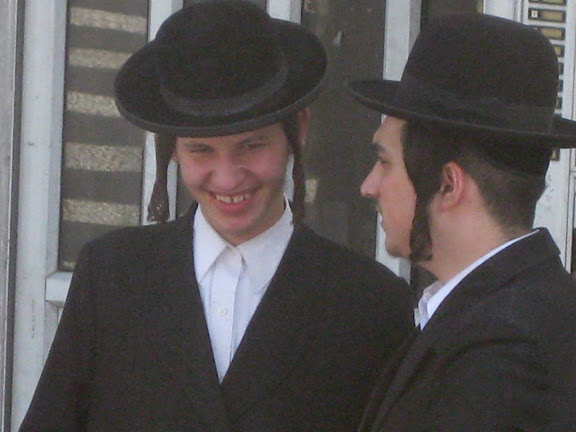
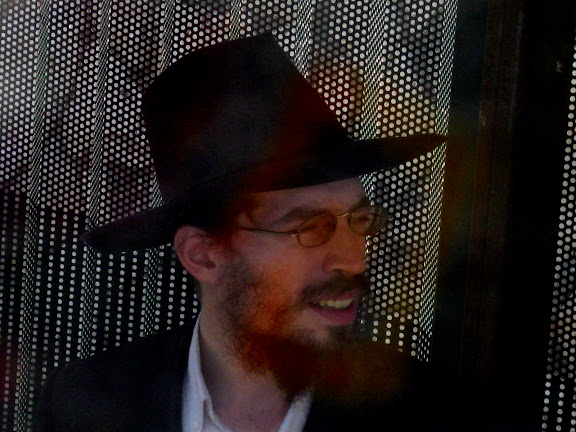
I already liked this website, because it is funny, if biased (it never claimed to be objective), and because they have a great listing of cultural events in the area. But now I'm a fan for life!
The Jerusalemite site requests the stories of how various sects came to choose their hats. Answer: I have absolutely no idea. But I will try to find out. Anything for my fans. If any of you know, or can think of a way to get more information about it, please let me know!
This post will be tourist headgear. Our visitors have to protect themselves from the sun, and they do so in any number of ways. Enjoy!
N.B. I should point out, for all but one of these subjects, I don't know for sure that they are tourists. I am just guessing based on my experience as a dweller of the city. But it is possible I have miscast some of them. If so, I apologize.
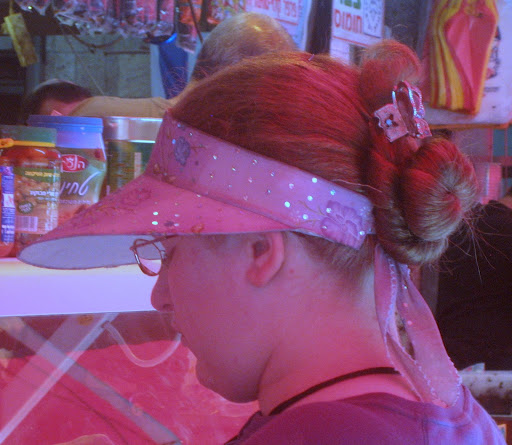
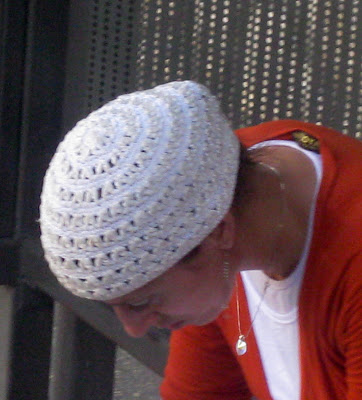
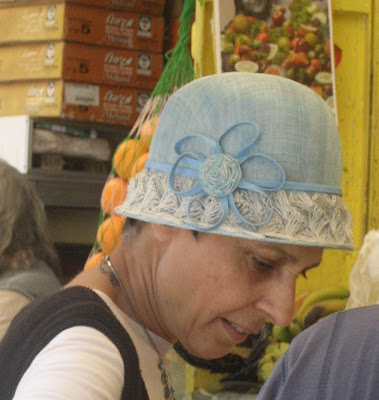
Pretty in Pink - this was taken at Machane Yehuda. For those not in the know, Machane Yehuda is one of the two shuks in Jerusalem. (Unless there is also one in East Jerusalem - I admit to ignorance on that count.) Machane Yehuda is primarily Jewish - Arabs work there, but Hebrew is the language of the place, and most stands are kosher, though not all. The majority of the stands sell food, but there is also houseware and some clothes. Of late, cafes have been springing up, and some higher end clothing stores, a trend I vigorously oppose. This is supposed to be the market of the proletariat! Most egregious, Aroma, the Starbucks of the Holy Land, has opened a franchise in the main avenue of the market. Blasphemy! But back to the subject, the market attracts hordes of tourists, especially the uncovered section, which is prettier, doesn't have raw meat featured in it, and has most of the tourist trap items offered. It isn't just for the tourists however, not by a long way. Many locals do their shopping here, as many things, particularly bread and produce, are fresher and cheaper here than anywhere else.
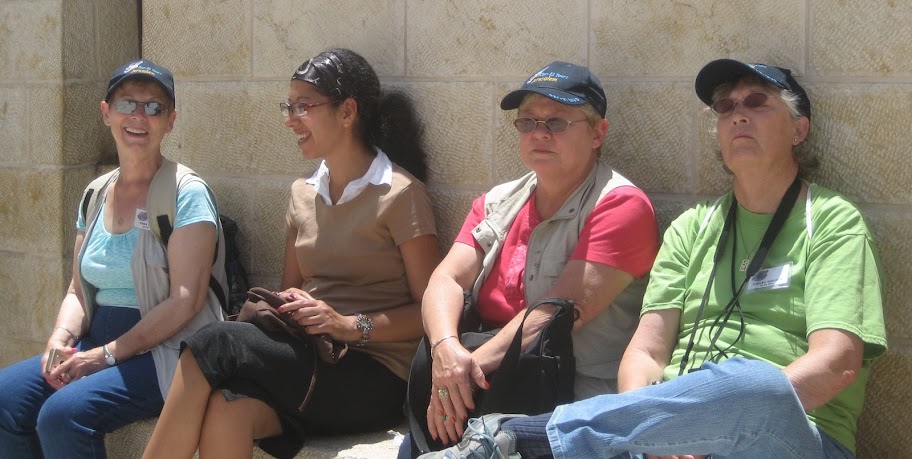
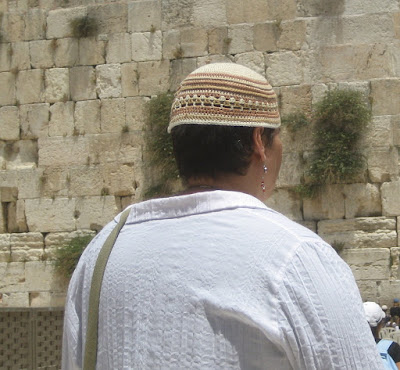
This was taken at the Western Wall, another major tourist attraction, though again, most definitely not only for tourists. This picture illustrates a common phenomenon here - the organized tour group. These people can be identified by their ubiquitous tour buses and the uniformity of age, among other things. Many of the groups are people in their late teens and early 20s, in large part because of the Birthright Israel program, which brings young Jews to Israel for free for about ten days, in the hopes of fostering an affinity between the youth of the diaspora and the Jewish homeland. This particular group doesn't seem to be a Birthright trip, as the participants are too old. They do, however, demonstrate an important feature of tour groups: the identifying article of clothing. Generally shirts, it seems this group has chosen hats as a way of marking themselves. Dorky? Maybe so, but it means the tour guides can find them more easily, and they are less likely to end up wandering the city, lost and alone.
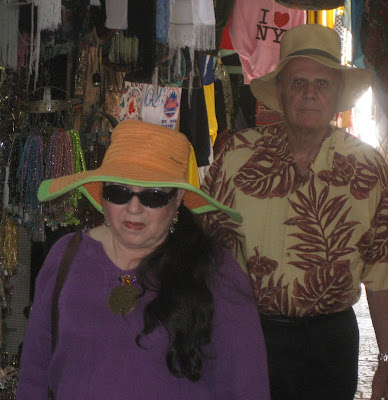
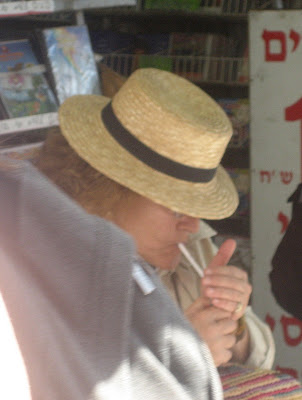
This is the other major shuk in Jerusalem - the Arab shuk. It is in the Old City, and is bigger and exponentially more confusing than its West Jerusalem Jewish counterpart. This is the sort of bazaar that one would imagine from reading Arabian Nights or the like. Walking around in it, you feel Aladdin's lamp might be hiding somewhere amidst the piles of junk, most of which, if you check carefully, announces that it is made in China. This market is frequented mainly by Arabs and tourists, and the predominant language is Arabic, though any salesman worthy of the name will have enough English to entice customers and drive hard bargains. Really anything can be found here, from rotten tomatoes to diamonds (or at least they claim to be diamonds. I'm pretty sure the rotten tomatoes are authentic.) Not that the salesmen need the hats to know these are tourists, but it does pretty much guarantee that they will pay at least four times the price that a local Arab would pay for the same item.
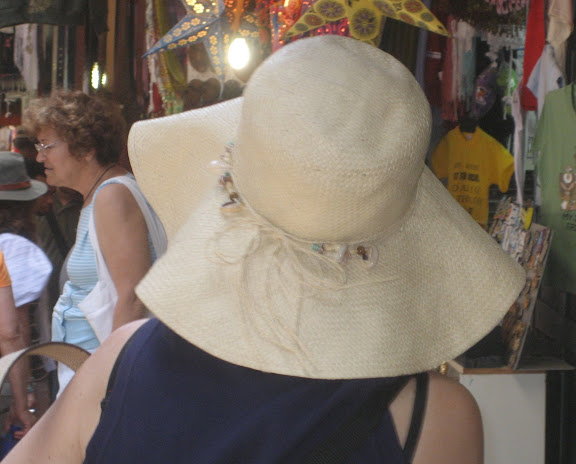
Another from the Arab shuk.
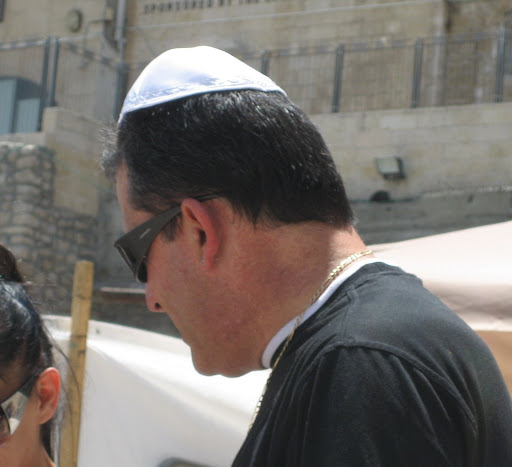
This is another important group - tourists (or secular Israelis) trying to show proper respect at the Western Wall. These people wear variations on traditional religious headwear, but manage to look incredibly uncomfortable while doing so. This is a classic example. Note the cheap fabric - probably a party favor from a bar mitzvah where guests weren't expected to have their own kepot, and the strong creases, which cause it to perch precariously on the top of the head, from years of being kept in a suit coat pocket. This is one group where it is very hard to tell true tourists from native Yerushalmis who are simply not part of the religious scene.
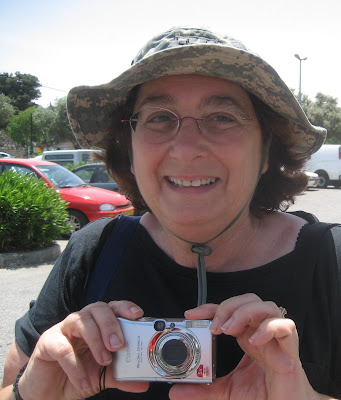
This is the one person I can guarantee is a tourist, as she volunteered to have her picture taken. Her hat is an authentic boonie hat (actual name), courtesy of the US Army. She stole it from her husband, who served in Iraq. I imagine it gives good protection from the elements; it was designed specifically for this area of the world.
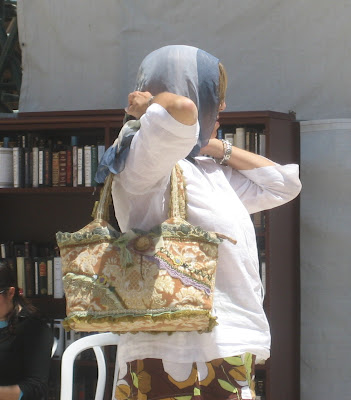
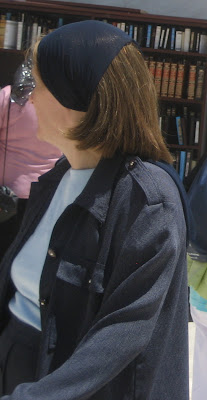
This is the female version of the Non-Religious-Jew-At-The-Wall. It's possibly her own scarf, but even more likely, one of the ones the soldiers have on hand to give to those who arrive without sufficient coverage. I included this picture already in the scarf centered entry, but I felt it deserved another showing here.
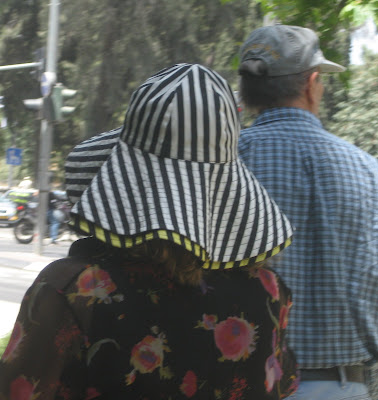
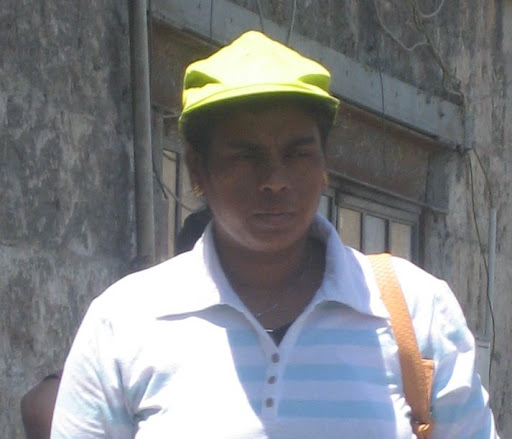
And this one, well, it was just too good to pass up.